
12 of the Fastest and Most Effective Ways to Get Out of Debt & Pay Down Debt
By Jordan Evans & Julie Jaggernath
A lot of people tell us that they would love to pay down their debt or completely get rid of it altogether, but they aren’t quite sure of the best way to do it or where to get started.
There really isn’t any one “best way” on how to get out of debt fast that works perfectly for everyone. So here are a dozen proven suggestions on how to manage debt problems to get you started. The more of these you can apply, the faster you will get out of debt.
How to Get Out of Debt Faster
Credit card debt, auto loans, student loans, personal loans… whatever you’re debt situation is, here are 12 tips to help you start working towards paying off all your debts.
1. Pay More Than the Minimum
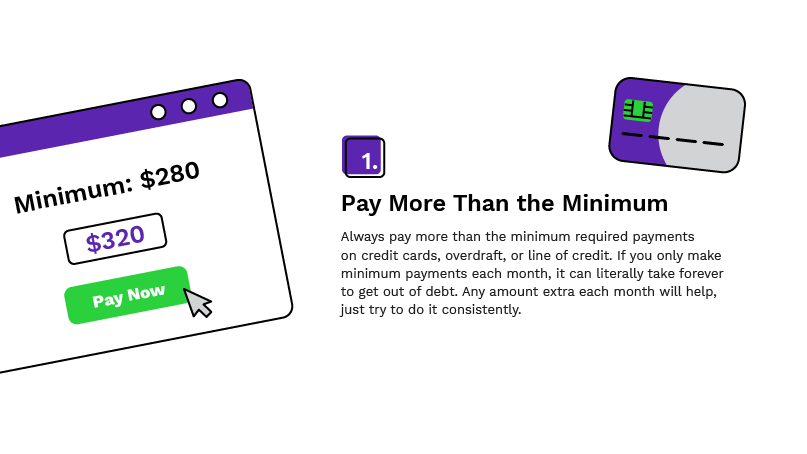
Make sure that you always pay more than your minimum monthly payments of your credit card balance, overdraft, or line of credit. If you only make your minimum credit card payments each month, it can literally take forever to pay off your balance. That’s because the majority of your minimum payment will go towards paying interest fees rather than reducing the amount you actually owe (i.e. the principal).
If you want to pay off your balance quickly, pay as much extra as you can afford. Even an extra $50 each month will help. Try using a financial calculator or our super helpful debt repayment calculator to see how much you can save like this!

2. Spend Less Than You Plan to Spend
Most of us have wishes and wants that are bigger than our paycheques. You might have heard the old saying, “You can have almost anything you want; you just can’t afford everything you want.” Many people get into debt and stay in debt because they tend to buy what they want, when they want. Not even millionaires can afford to buy everything they want. If you want something, don’t buy it unless you have the money. If you can be satisfied with less than you would ideally want, even temporarily, you can use the money you save to pay down your debt. By the time your debt is paid off, you’ll probably have adjusted to your new priorities, and you can use the money that you are saving to put towards other financial priorities.
Another great way to spend less is to pay with cash rather than credit. McDonald’s has found that people spend 56% more at its restaurants when they pay with credit rather than cash. Studies have shown that people spend 100% more at vending machines or on event tickets when they use credit. Overall, studies seem to show that people tend to spend at least 15% more on everything they purchase things using credit. If we apply this concept to an average Canadian household that currently buys everything with credit cards to collect points or get cashback, they would likely save well over $3,000 per year if they only bought stuff with cash instead (the points or cash back would only amount to $400 in value at best). Even if your savings aren’t as great as this example, you can probably see our point. If you want to get out of debt, leave the cards at home, use cash, and don’t buy things with credit until you’ve paid down your debt to the level you’re working towards.
3. Pay Off Your Most Expensive Debts First
One of the smartest strategies for getting out of debt is to make minimum payments on all of your debts and credit cards except for one. Chose the one debt that is charging you the most interest and focus all of your extra payments on paying off that one first.
Once your first, most expensive debt is paid off, take all of that money that you were paying on that first debt and focus it on the next most expensive debt. Continue this method as you pay down each of your debts, and you will be left with your least expensive debt to pay down last. This strategy is called the Avalanche Method and will get you out of debt quickly. It can also help you feel encouraged as you see your progress. There is also a different variation of this strategy that a lot of people find even more motivating. It’s called the Snowball Method. You can learn more about it to see if it might work better for you, or you can try it out and compare both the Avalanche and Snowball Methods.
Related: Where to Find Money to Save Each Month So You Can Pay Off Your Debt More Quickly
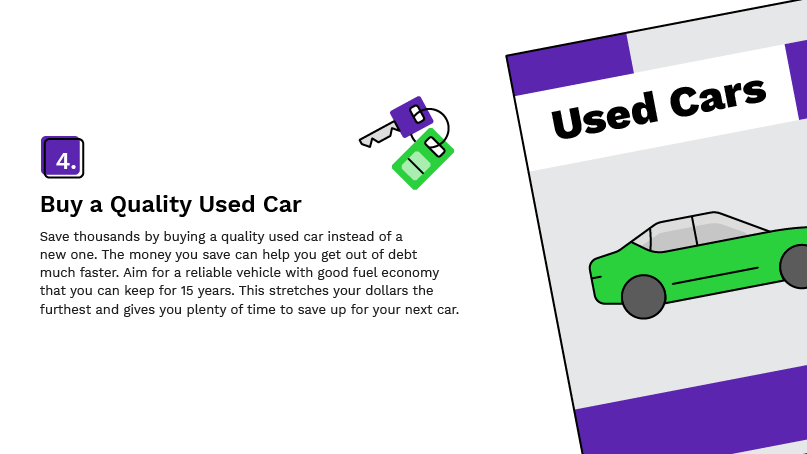
4. Buy a Quality Used Car Rather than a New One
Dave Ramsey, a popular personal finance radio host, once said that, “A new $28,000 car will lose about $17,000 of value in the first four years you own it. To get the same result, you could toss a $100 bill out the car window once a week.”
The lesson here is that you can save yourself thousands of dollars if you buy a quality used car rather than a new one. The money you save can help you get out of debt much faster. Go to your local library and look in the Consumer Reports or Phil Edmonston’s Lemon-Aid books to find a quality used vehicle.
If you do choose to buy a new car, Consumer Reports has always recommended choosing a reliable car with good fuel economy, and then they suggest you keep it for 15 years. This will stretch your dollars the furthest and keep you out of debt as you will have plenty of time to save up for another new car.
5. Consider Becoming a One Car Household
If your family has two cars, consider getting rid of one and either walking to work, taking transit, or car pool. You can literally save yourself thousands of dollars a year by only using one car. The average vehicle owner spends over $9,000 per year to own and operate their vehicle. If you use this money to pay down your debt, it will make a massive difference. However, instead of going cold turkey and selling your second car right away, try test driving this idea first. Parking your car for a while, drop the insurance down to pleasure use only, and see if taking transit, walking, cycling or car pooling works for you. If you do decide to sell your second car, even the odd taxi trip or rental car won’t amount to nearly as much as you would pay keeping your second vehicle permanently. If there is any chance that transit might work for you, this option alone is often 80% cheaper than owning and operating a vehicle.
6. Save on Groceries to Help Pay Off Debt Faster
To save some money to pay off your debt faster, try stocking up on groceries when they are on sale, or go one step further and stockpile when they are on sale and then skip one grocery shop every month and live off of the food you stockpiled. You can stockpile non-perishable groceries like canned goods, cereal, and things that you can freeze like bread and meat. Filling your cupboards when groceries are on sale and then skipping one grocery shop each month can save you up to 25% on your annual grocery bill. A family of four could possibly save $2,300 to $2,900 a year by doing this. Applying these kinds of savings to your debts, will definitely put you ahead in the long run!
The key to this strategy is watching for sales, only stocking up when groceries are on sale and freezing foods properly. When you “skip” a grocery shop, you will still need to buy perishable groceries like milk, fruit, and vegetables, but hopefully you can skip the rest of what you would normally buy. If you can’t skip a shop once a month, then try for once every other month. That can still save you a fair amount of money. For many more ways to save on groceries, check out these tips.
Related: 7 Spending Tips That Can Save You Thousands of Dollars
7. Get a Second Job and Pay Down Your Debt Aggressively
Getting a second job, or consistently picking up an extra shift or two, is a common way for many people to pay down their debt. This strategy for becoming debt free doesn’t work for everyone, but if you can make it work, you could be debt free within a short number of years. For this to work, you must apply all of your extra income to debt repayment. Working the extra shifts or hours also doesn’t need to be permanent. Once your debts are paid off, you can look at scaling back again.
You could also consider generating some extra income to pay down your debt by capitalizing on a hobby you enjoy, or a skill set you might have. For example, if you happen to be a good writer, consider freelancing articles for blogs, newspapers, media outlets, or on a freelance website. If you’re crafty, consider selling your creations on Etsy. If you’re a handyman, see if you can pick up some extra jobs (you may even be able to find websites that can help connect you with people who need your skills).
Some people also use their home to generate some extra cash. Is it possible for you to rent out your basement, rent out the storage space in your garage, rent a room in your house (you could maybe do this on Airbnb), or can you take in a student for some extra income?
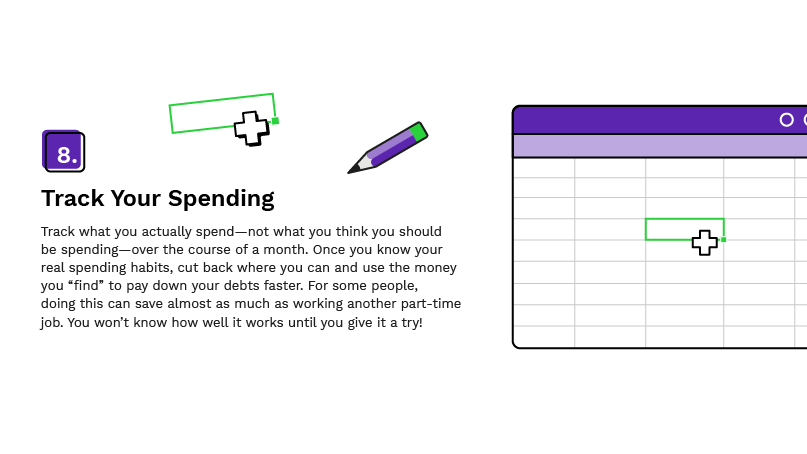
8. Track Your Spending and Identify Areas to Cut Back
For some people, doing this can save them almost as much money as working a part time job. You won’t know how much you can save unless you give this a try. Track what you actually spend—not what you think you should be spending, over the course of a month. If you aren’t honest with yourself in this exercise, it won’t work, but most people are surprised by what they find out about their spending. Once you know your spending habits, you should be able to identify areas where you can cut back. Allocate the money you “find” to paying down your debts.
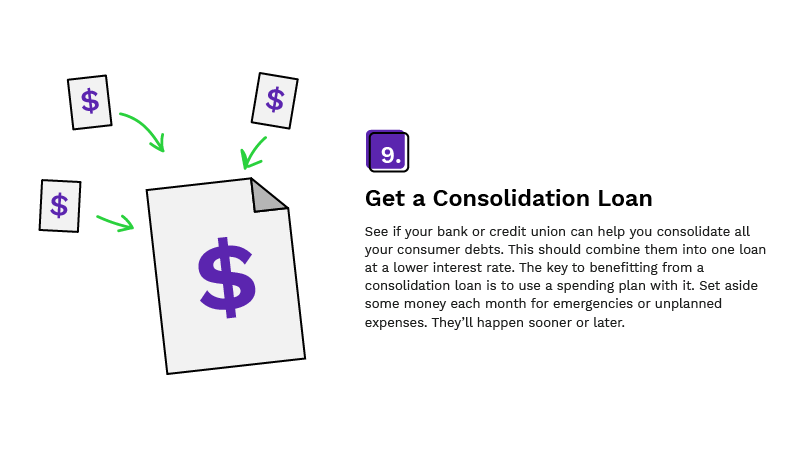
9. Get a Consolidation Loan
See if your bank or credit union can help you consolidate all of your consumer debts into one loan with one payment at a lower interest rate. This can be a helpful first step in getting your debt paid off. However, getting a debt consolidation loan will only help if you create a budget that does two things:
- It helps keep you from building up new debt while you’re paying off the consolidation loan.
- It allows you to save a bit of money every month.
Savings isn’t usually what someone in debt thinks of first, but if you don’t have savings, you’ll likely need to use your credit cards again part way through your loan and end up racking up more debt. The end result could leave you in the same place as before or even worse off. A U.S. bank that reviewed all its debt consolidation loans over a number of years discovered that over 70% of people who took out a debt consolidation loan from them were no better off financially after repaying these personal loans. This happened because these people did not solve their underlying problem of spending more than they earned.
So the key to benefiting from a consolidation loan and making it an effective tool is to use a spending plan (a budget) to ensure you keep your spending under control and set aside some money each month for emergencies or unplanned expenses which will inevitably occur.
If you want to explore this repayment option further, you can compare a debt consolidation loan to other repayment methods and see which one would work the best for you.
Find Out What Options May Be Available to You
by Answering 9 Simple Questions
Just answer these easy, multiple-choice questions to get a look at your potential options. Within a few minutes, you'll be looking at summarized options and results that apply specifically to your situation.
Discover Your Options
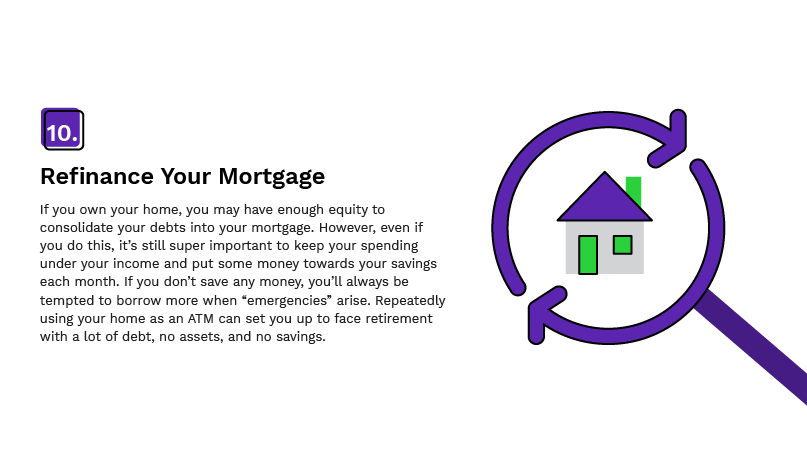
10. Refinance Your Mortgage
If you own your own home, you may have enough equity to consolidate all of your debts into your mortgage. If you don’t have much equity in your home, additional mortgage insurance costs may be expensive. Make sure you consider all of your options and seek advice from someone other than your lender (since they have a vested interest in getting you to choose this option). If a normal bank or credit union isn’t able to help you, don’t rush off to find the first home equity finance company that is willing to give you the money. Instead, have a conversation with an accredited, non-profit Credit Counsellor first. You may have better options other than refinancing your home that you’re not aware of. They can help you assess all your options and come up with the best plan to move you forward and accomplish your financial goals.
If you do refinance your home and consolidate debts into your mortgage, you need to think of the new mortgage like the debt consolidation loans we discussed above. It’s super important that you keep your spending under your income (following a budget is usually the best way to do this) and allocate money to each month to savings. If you don’t save any money, you’ll always be tempted to borrow more when “emergencies” arise. Repeatedly using your home as a bank machine can set you up to face retirement with a lot of debt, no assets, and no savings. If this is something you’re struggling with, read on.
Related: How to Pay Down Your Mortgage & Loans Faster & Save Money
11. Speak with a Credit Counsellor – It’s Free
If you are in debt and are really struggling to make any headway paying down your debt, start by speaking with a credit counsellor. Find out what programs are available to help you deal with your debts. A reputable credit counsellor will explain all of your options and help you choose the option that makes the most sense for you in your situation. Many people don’t know what they need to know about debt repayment programs at non-profit credit counselling organizations, but most are relieved they took the time to find out before it was too late. Speaking with a non-profit credit counsellor about your options is confidential, non-judgmental, and usually free.


I will have my finances back on track
This place is truly amazing. I met with [a credit counsellor] today and she was more than helpful when it came to making up a debt repayment plan for me. I can finally have a good sleep tonight knowing I will have my finances back on track.
Nat
12. Create a Spending Plan
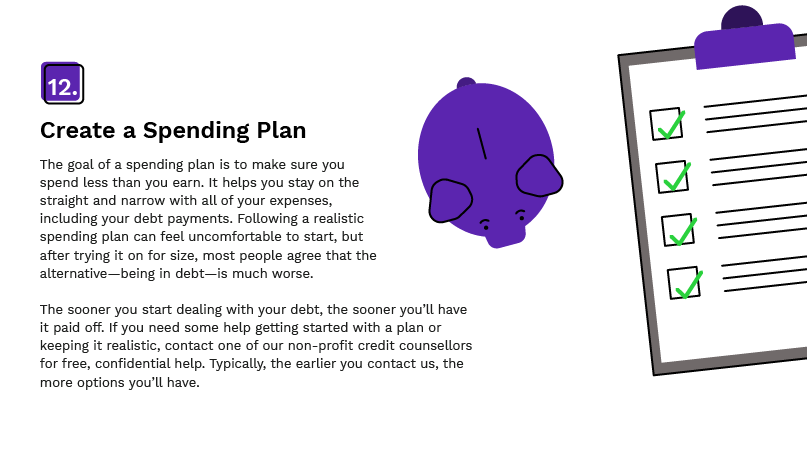
Okay, so the “b” word has to fit in at some point. In truth, a budget is just a spending plan. It will help you stay on the straight and narrow with your current debt payments, or your new accelerated payments. A spending plan is something you lay out to make sure that you are spending less than you earn.
Some people say that they don’t like budgets, but have these people ever tried one? Better yet, if you’ve lived all this time without a budget, how do you know you won’t like having one? After trying a realistic budget on for size, most people agree that the alternative—being in debt—is much worse. To learn how to create a budget, click here. We’ve also built a budgeting tool that can guide you through the budgeting process to make budgeting as easy as possible.
Last Updated on October 6, 2026
How to Get More Help to Get Out of Debt Faster
The sooner you start dealing with your debt, the sooner you’ll have it paid off. The next few years will pass whether you pay it off or not, so start by trying at least one or two of these strategies. You’ve really got nothing to lose!
If you need some help getting started with a plan, or if you’re not sure if your budget is realistic, contact a non-profit credit counsellor for free, confidential help. You can meet with them over the phone or in person, and they don’t obligate you to anything. The counsellor will review your whole situation with you and then suggest options to help you reach your goals. Typically, the earlier you contact a credit counselor, the more options you’ll have.


I need help with Debt
Hello Hammersdale, thank you for reaching out to us. Our team will contact you through the email address listed on your account. You can also call us toll-free at 1-888-527-8999. We look forward to helping you!
I need to get rid of my debts Asap its so stressful
Hello Diya, we’ll be happy to help you as well. Our team will contact you through the email address listed on your account. You can also call us toll-free at 1-888-527-8999.
Very, very helpful and insightful. I’ll work on your tips to get out of my current situation. Thanks
Please advice the best plan to pay off $15k in LOC @ 5.25%?
I am 60 y/o widow
My options:
I am getting a credit card balance transfer for 10 months @ 1% transfer fee ($150) / 12 month @ 3 % ($450). Currently, laid off and on very tight budget
Take $$$ from RRSP to pay off debt and pay the high penalty? Will this give me a break on my taxes due to being laid off? Then I could put $$$ every month into TFSA for emergency. So complicated!!!! Thank you in advance for your help.
Hi Zofia, Thanks for your questions. Because there are so many factors impacting this decision you’re about to make, this is a discussion you need to have either over the phone or in person with someone. You are welcome to speak with one of our credit counsellors. Speaking with them is free, and they could help you look at all your options and then help you put together a plan that’s going to work best for your financial situation. On the tax side of things, you’ll probably need to get advice from your tax advisor, but there too, the credit counsellor could probably point you in the right direction if you don’t know who to talk to. To speak with one of our credit counsellors, feel free to call us at 1-888-527-8999.
Nice post. I learn something new and challenging on blogs I stumbleupon everyday. It’s always helpful to read content from other authors and practice something from their websites.
I have 30k in two credit lines, a credit card, and overdraft. I was just hired as a permanent teacher and have a good outlook on my income over the next 5 years but cannot figure out how to pay my debt down without either filing for bankruptcy or applying for a consolidation loan. I’m trying to not ruin my credit at the age of 32 when the next few years are looking positive. Can you please discuss other options with me? Thank you.
Hi Lucien, Congratulations on the new job. There could possibly be a number of ways that you could approach this problem. The best thing would be to start by speaking with one of our credit counsellors. They’ll go over your situation with you and then can lay out all your options based on the specifics of your situation. They’ll then discuss the pros and cons of each option with you and help you figure out what will work best based on your budget and your financial goals. Feel free to give us a call at 1-888-527-8999.
Hi, I made a mistake of taking money from loan sharks and am experiencing collection harassment. I am so down and no longer know what to do.
Hi Cheryl, Thanks for reaching out. The best thing to do is to contact a non-profit credit counselling organization like ours, go over your situation with a credit counsellor, and then they’ll help you put together a plan to stop the harassment and get your situation back on track. Feel free to call us at 1-888-527-8999.
whoah this blog is great i love reading your articles. Keep up the great work! You know, lots of people are hunting around for this information, you could help them greatly.